Frequently Asked Questions
How do I choose the best solar LED lights for outdoor use?
Choose solar LED lights with 100-3,000+ lumens, a battery capacity of 2,000-10,000 mAh, and an IP rating of IP44-IP67 depending on exposure. Match lumens to purpose (100-400 lm for pathways, 1,000-3,000+ lm for security), prefer 8-12 hours low-mode runtime, and select panels with 2-10 W output for reliable charging. IP rating (Ingress Protection) and battery mAh (milliampere-hour) are critical specs to check. Consider motion sensors for security and dimmable modes for ambiance; prioritize grade A materials and a 1-3 year warranty where available.
What IP rating do I need for exterior solar lights?
Select IP44 for sheltered locations, IP65 for fully exposed areas, and IP67 or higher for ground-level or near-water installations. IP rating (Ingress Protection) uses two digits: the first (0-6) for dust protection and the second (0-9) for water protection. IP44 protects against solid objects over 1 mm and splashing water; IP65 protects against dust ingress and low-pressure water jets; IP67 protects against temporary immersion up to 1 m. Choose IP65 for driveways and exterior walls, and IP67+ for installations near ponds or where brief immersion is possible.
What does IP65 mean for solar outdoor lights?
IP65 means complete protection against dust ingress (6) and protection against low-pressure water jets from any direction (5). The IP rating (Ingress Protection) has two digits: the first (6) indicates dust-tight enclosure, the second (5) indicates resistance to water jets. Practically, IP65 solar lights are suitable for exposed walls, driveways, and garden areas where rain and dust are common. IP65 is not rated for continuous immersion; for installations that may be temporarily submerged, choose IP67 or higher.
How do solar lights with motion sensors work?
Solar lights with motion sensors use PIR (passive infrared) sensors to detect changes in infrared radiation caused by moving people or animals, typically triggering high output for 10-120 seconds and extending battery life. When motion is detected within about 3-10 meters (model-dependent), the light switches from low ambient mode (8-12 hours runtime) to full brightness for the set duration. Many models allow adjustment of sensitivity, detection range, and on-time. Motion activation improves energy efficiency, enhances security by startling intruders, and preserves battery cycles compared with constant high-output operation.
What is the typical color temperature for exterior solar LED lights?
Common color temperatures for exterior solar LED lights are 2,700K-3,000K (warm white) and 4,000K (neutral white); 4,000K is widely used for security and task lighting, while 2,700K-3,000K creates a warm, inviting ambiance. Also consider CRI (Color Rendering Index): aim for CRI 70-90 depending on how accurately you want colors rendered. Use 4,000K for driveways and work areas, and 2,700K-3,000K for patios, gardens, and hospitality spaces to match existing lighting and avoid jarring contrasts.
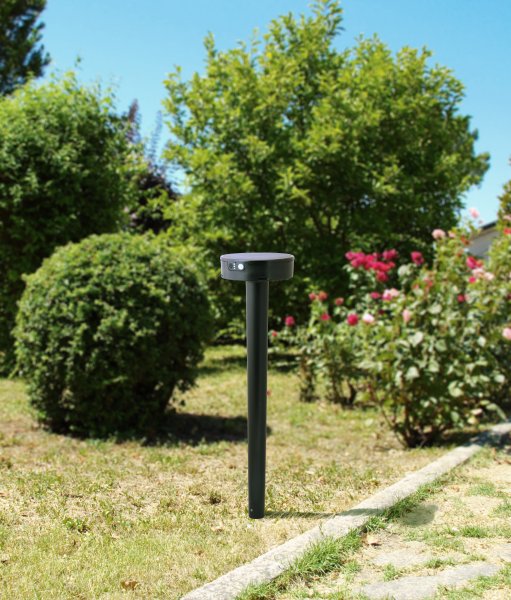
Where are solar bollard lights best used in a garden?
Solar bollard lights are best used to define pathways, mark garden borders, and improve safety around steps when installed 600-1,000 mm high and spaced 1-3 m apart. Bollards at 600-800 mm provide low-glare ground illumination; 800-1,000 mm heights give broader spread for larger paths. For effective performance choose 100-400 lumens per bollard, a battery of 2,000-6,000 mAh, and IP65 for exposed gardens. Position bollards to avoid direct glare into eyes and align spacing to create overlapping light pools for consistent visibility.
What is the difference between solar wall lights and solar floodlights?
Solar wall lights typically provide 100-800 lumens for accent, entry, or short-range pathway lighting, while solar floodlights deliver 1,000-3,000+ lumens for broad-area illumination and security. Wall lights mount on vertical surfaces and use narrower beams for localized lighting and aesthetics; floodlights use larger panels and higher wattage-equivalent LEDs with wide beam angles for yards, driveways, or work zones. Floodlights usually require larger solar panels (5-20 W) and batteries (5,000-10,000 mAh) to sustain high output, whereas wall lights can operate with smaller 2-6 W panels and 2,000-5,000 mAh batteries.
How to choose solar LED lights - Type and brightness guide
Enhance your exterior with solar LED lights designed for reliability, from driveway bollards to durable security floodlights. This guide helps you understand important specs-like lumens and IP ratings-to ensure your outdoor lighting performs in any weather.
Match the style to your location for the best results. Use solar bollard lights (600mm or 800mm) to define pathways, or install solar wall lights for focused porch lighting. For wide-area security, choose high-intensity solar floodlights. When comparing brightness, prioritize lumens over wattage (1.5W-200W) to judge true light output.
- Pathway: 50-400 lm
- Patio/Task: 500-1,500 lm
- Security/Flood: 1,000-5,000+ lm (look for high-output models like 1,100 lm or 2,600 lm)
- Expert Tip: Always check the beam angle to estimate coverage area rather than relying on wattage alone.
IP ratings: Choosing IP44, IP55, or IP65 solar lights
The IP rating indicates weather resistance. For sheltered porches, IP44 solar lights are sufficient. For exposed walls or driveways, upgrade to IP65 to ensure protection against heavy rain and water jets.
Battery & features: Motion sensors, adjustable beams, and dimming
Check specs for battery chemistry (e.g., Li-ion) to predict run-time. Save energy with motion sensor solar lights (PIR) that turn on only when movement is detected. Features like adjustable beam angles and integrated LEDs offer precise control and sleek design.
Filter our solar LED lights by brands like Ener-J and Fumagalli to find the right fit. Compare IP ratings, lumens, and features like dimming to get the best lighting for your home.
Call us on
021 4975201