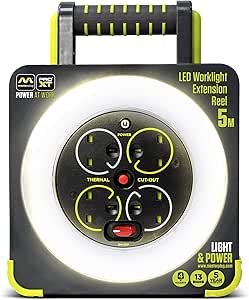
The right LED work lights are essential for safety and precision during workshop tasks, vehicle inspections, or on a construction site. Our range includes everything from compact models to temporary lighting for walkways, such as festoon light strings. This guide will help you select the best rechargeable LED work light or portable LED work light by matching brightness, power source, and durability to your specific needs. Always check detailed specifications, such as lumens and IP ratings, on the individual product pages.
Frequently Asked Questions
How do I choose the best rechargeable LED worklight for a workshop, garage, or site?
To select the best rechargeable LED worklight for your workshop, garage, or site, look for a model with an output of 500-4,000 lumens and a runtime of 5-12 hours on a medium setting. It should have an IP65 rating or higher for dust and water resistance, along with at least two mounting options, such as a magnetic base and a hook. It is important to prioritise the actual lumen output over the advertised wattage, and consider the battery capacity (measured in mAh or Wh) and whether it is replaceable. You should also compare the beam angle and colour temperature (CCT) to suit the task; narrow beams are ideal for focused inspections, while wide beams are better for illuminating larger areas. Finally, choose models from reputable brands and check customer reviews for feedback on real-world performance and durability.
What wattage or lumen output LED worklight is suitable for a garage?
For most garage tasks, a 10W-30W LED worklight, providing approximately 700-4,000 lumens, is ideal. A 10W unit is sufficient for close-range inspections, whereas a 30W model can effectively light up larger bays. Your choice should depend on the required coverage area, beam angle, and mounting height. We recommend 700-1,500 lumens for bench work and 1,500-4,000 lumens for illuminating the entire garage. It is also wise to consider the runtime at your desired brightness, battery recharge time, and colour temperature; a range of 4000K-5000K ensures accurate colour rendering. For permanent overhead fixtures, mains-powered options may be more suitable than portable rechargeable units.
Can I use an LED worklight outdoors in wet or rainy conditions?
Yes, many rechargeable LED worklights are designed for outdoor use in wet conditions, provided they have an IP65 rating or higher. The IP (Ingress Protection) rating indicates a device's resistance to dust and water. An IP65 rating is sufficient for protection against rain and splashes, as it safeguards against water jets and dust ingress. If there is a risk of the light being submerged, you should choose an IP67 or IP68 rating, which offers protection against temporary or continuous immersion, respectively. Always check the seals and charging port covers, and consult the manufacturer's guidance regarding use in saltwater or for prolonged periods of exposure.
How long does a rechargeable LED worklight battery typically last on a single charge?
The battery life of a rechargeable LED worklight varies significantly, typically from around one hour at maximum brightness to over 12 hours on low or eco settings. This depends on the battery's capacity (usually between 2,000-20,000 mAh or 10-100 Wh) and the selected brightness level. Manufacturers usually specify runtimes for each mode, with full floodlight settings consuming power much faster than low or torch modes. For longer jobs, consider models with replaceable batteries or use a lower brightness setting to conserve power. You should also check the recharge time, which can range from two to eight hours.
What is the practical difference between a 10W and a 30W LED worklight?
The main practical difference is brightness. A 30W LED worklight typically produces 1,500-4,000 lumens, making it two to four times brighter than a 10W unit, which usually offers 700-1,500 lumens. This means a 30W light can illuminate larger areas more effectively. Higher-wattage lights also tend to have wider beam angles but generate more heat and have a shorter battery life at maximum output. A 10W light is more portable and efficient for focused tasks and inspections, while a 30W light is better suited for lighting entire rooms, site work, or large garage bays.
Is a magnetic LED worklight strong enough for automotive and overhead tasks?
Yes, magnetic LED worklights featuring strong neodymium magnets or an advertised holding capacity of around 2-10 kg are generally robust enough for most automotive tasks, including being attached overhead to a vehicle's bonnet or chassis. It is always best to verify the magnet's strength by checking the product specifications or customer reviews. We recommend models with recessed magnets and rubberised bases to prevent scratching the paintwork. For frequent overhead work, a light with multiple mounting options, such as a magnet, hook, and tripod mount, offers greater versatility and safety.
What does CCT mean in an LED worklight and which value should I choose?
CCT stands for Correlated Colour Temperature and is measured in Kelvin (K). For LED worklights, this value typically ranges from 3000K to 5000K. A CCT of 4000K-5000K is ideal for most workshop and inspection tasks, as it produces a neutral to cool white light that enhances contrast and makes it easier to distinguish colours. Lower CCT values, around 3000K, create a warmer, yellowish light that is better suited for general ambient lighting. You should also consider the CRI (Colour Rendering Index); a value of 80 or higher is recommended for tasks that require accurate colour perception, such as inspections and repairs.
Understanding LED work light brightness - lumens vs watts
When selecting a bright LED work light, it is important to check the lumen output and beam angle, not just the wattage. Lumens define the actual brightness, while the beam angle determines the size of the area you can illuminate. Match the specifications to the task: lower values are sufficient for precise inspection work, workshop lighting requires medium power (from around 10W to 30W, or 800-2000 lumens), whereas construction site illumination calls for models of 30W and above.
For example, a folding 10W LED work light is ideal for close-up workshop tasks, while a 30W LED work light will provide broad illumination for an entire room. Relying solely on wattage is a common mistake - if a product page is missing information on lumens or beam angle, contact us for assistance in selecting the right equipment for your needs.
Selecting the right power source for an LED work light
The choice of power source is a trade-off between portability and continuous run time. Consider where you will be using the equipment and how long it needs to operate without interruption:
- USB charging: A good solution for emergency lighting and short tasks where maximum portability is a priority.
- 18V battery (cordless): An excellent choice for professionals who can use their existing 18V batteries for quick power swaps during a job.
- 110V mains power and festoon strings: A reliable solution for long-term lighting on construction sites or in corridors, ensuring uninterrupted operation without charging breaks.
When choosing a rechargeable LED work light or a USB-powered model, check the battery capacity (in mAh or Wh) and the charging time. To extend the run time, look for devices with multiple lighting modes (high, medium, low), which allow you to easily balance brightness and energy consumption as needed.
Durability and mounting options for an LED work light
A construction site LED work light must be able to withstand harsh conditions. For outdoor work in the rain, choose waterproof LED work lights with a minimum rating of IP65 (or IP67/IP68 if there is a risk of submersion). On demanding construction sites, models with polycarbonate lenses, protective cages, and a high IK mechanical impact rating are best. The mounting method also determines convenience: a magnetic LED work light frees up your hands during vehicle repairs, while festoon kits are perfect for illuminating walkways.
- Expert tip: When choosing a magnetic LED work light, do not assume it will support its own weight in every position. Always check the magnet's holding strength in the specifications or user reviews.
If a product description is missing IP or IK rating information, please contact us before making a purchase to ensure the equipment can withstand drops and tough site conditions.
Choose the right model to ensure a safe and efficient working environment. Use the filters to narrow your search by specific brands or power source types, and visit the product pages to check the exact lumen output, IP rating, and battery run time. If you need assistance selecting the right LED work lights, please contact our customer service team - we are happy to provide any missing technical specifications.
Call us on
021 4975201